
Visiting Hagia Sophia in Istanbul is one of those moments that stays with you. But if you move around in a wheelchair or have limited mobility needs, the magic of this place can turn into an obstacle course.
That’s why this guide was created: to help you understand what to expect, how to prepare, and which areas you can really explore serenely.
In recent years, Istanbul has made significant strides on the accessibility of its historic sites, including religious sites.
But beware: Hagia Sophia is not a traditional museum.
Since 2020 it has reverted to being an active mosque. This entails special rules at the entrance and an interior structure that may not be entirely comfortable to walk around.
We will give you practical and up-to-date information on:
- accessible entrances,
- visitable areas without barriers,
- services available for those with disabilities,
- and some tips to avoid nasty surprises.
Whether you are planning your trip or just considering whether to include Hagia Sofia in your itinerary, here you will find only what you really need to know.
Do you already want to find out how to book access or check entry times and procedures? Take a look at our Hagia Sofia ticket page!

Best Selling Ever
Hagia Sophia: Skip-the-line ticket
Avoid the ticket line and enter Istanbul’s most impressive mosque
Secure payment
Instant confirmation
Mobile ticket
How to reach Hagia Sophia (for the disabled)
Reaching Hagia Sophia in a wheelchair is possible, but you need to know a few things in advance.
The mosque is located in the heart of the Sultanahmet district, one of the most touristy and crowded areas of Istanbul.
This means that, especially during the middle hours of the day, the flow of people can make access complicated.
The most convenient way to get there is by streetcar, particularly the T1 line.
The nearest stop is just Sultanahmet, a few hundred meters from the entrance. The route from the station to the mosque is slightly uphill, but walkable.
The road surface is mostly smooth cobblestones, so it is fairly smooth, although it can be uncomfortable in some sections with a manual wheelchair.
The accessible entrance is located at the west corner of the building, between Alemdar Caddesi and Ayasofya Meydanı.
Here there is direct access to the ticket office and security checkpoint, with no significant architectural barriers.
It is also possible to arrive in this area by car or cab: you can be dropped off right near the entrance, which is especially useful if you use an electric wheelchair or have little independence in walking.
Once you arrive, on-site staff are generally available to help.
On rainy or windy days, opening the doors may require assistance from them, but on milder days they are left open for easy access.
Accessible entrance to Hagia Sophia
The accessible entrance to the Hagia Sophia Mosque is well marked and is located at the west corner of the building, at the intersection of Alemdar Caddesi and Ayasofya Meydanı.
This is the point from which you may want to access if you move in a wheelchair or need to avoid steps and barriers.
Here you will find a level path to the ticket office and the first metal detector checkpoint. Even when crowded, the flow is well managed by the staff, and you can ask for assistance if you need it.
The ramps present are short but functional: each measures about one meter, with a gentle slope and non-slip surface. They allow you to easily overcome the small differences in height that separate the outside from the center aisle.
Access is generally provided for all standard wheelchairs. In case of bad weather, the doors are not automated, but during visiting hours there is always someone from the staff ready to open them or provide support.
Keep in mind that since this is an active mosque, the universal rule applies at the entrance: enter without shoes.
If you use a wheelchair, the staff may tape the wheels or invite you to use a courtesy wheelchair available for visitors.
This is a way to protect sacred rugs and is applied to everyone, regardless of disability. If you have room in your suitcase, bringing a roll of packing tape may be a good idea.
What can be visited

ID 6796138 © Hasan Can Balcioglu | Dreamstime.com
Once inside Hagia Sophia, the good news is that most of the area on the ground floor is wheelchair accessible.
The floor is flat and step-free, with smooth surfaces that allow a visit without too much difficulty. You will be able to admire the impressive arches, Byzantine decorations, and striking Ottoman details up close.
There are some small internal ramps that allow you to overcome the structural overhangs without obstacles. These ramps are short, with moderate inclines, making it possible to move from one section to another without assistance.
However, the second floor is not accessible. To reach it, there are only stone stairs and historic ramps that are very steep, long, and often slippery. There are no elevators or stair lifts.
If you are in a wheelchair, you will still be able to visit about 70 percent of the building, including the entire main nave and the most spectacular areas of the prayer area.
The view from the top, with the famous mosaics on the upper level, is not accessible at the moment, unless you can walk independently and tackle numerous steps.
It should also be mentioned that there are no official guided tours designed for people with mobility disabilities.
However, if you wish, you can hire a private guide: in that case the tour will still be conducted entirely on the ground floor, without stairs or barriers.
In summary: no significant barriers on the ground floor, but access to the upper floors unfortunately remains excluded.
Hopefully, more inclusive solutions can be introduced in the future in this direction as well.

Best-selling ever
Hagia Sophia: Skip-the-line ticket
Avoid the ticket line and enter Istanbul’s most impressive mosque
Secure payment
Instant confirmation
Mobile ticket
Toilets, assistance and aids for visitors with disabilities
ID 6796138 © Hasan Can Balcioglu | Dreamstime.com
One of the most critical aspects to know before visiting Hagia Sophia concerns the presence (or absence) of accessible services.
The structure, originally built in the 6th century, was certainly not designed to accommodate modern visitors, and not all adaptations have yet been completed.
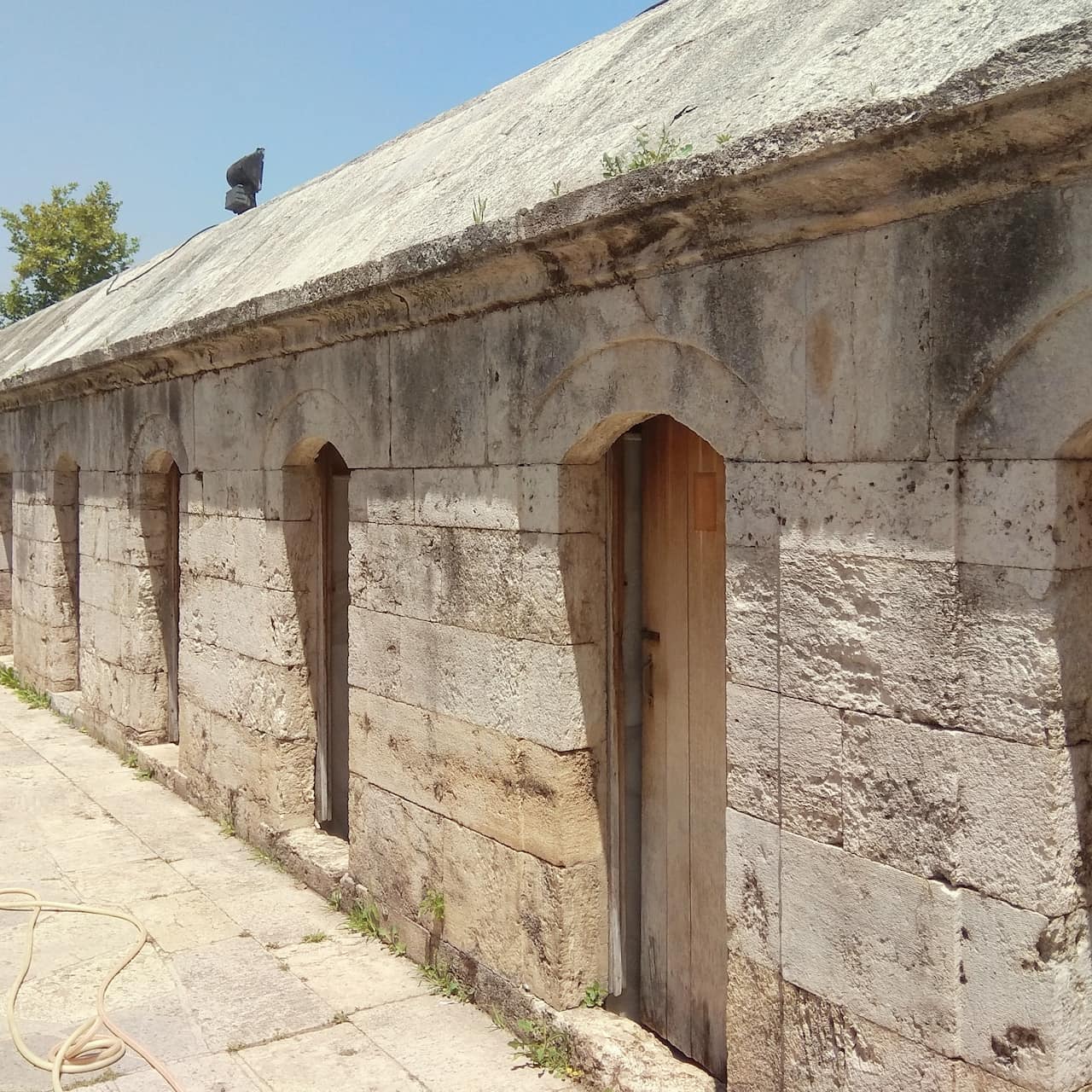
Let’s start with accessible toilets: there are no disabled toilets inside the mosque.
This is an important fact to consider, especially if you plan a long visit.
The nearest restrooms with easy access are located outside in the surrounding public areas, such as near the Istanbul Archaeological Museum or in the Sultanahmet Park area.
They are generally signposted and, in most cases, barrier-free.
No rental wheelchairs or dedicated assistance stations are available for visitors with disabilities.
However, staff on site are usually cooperative and ready to help.
If you need support in crossing the entrance or pushing your wheelchair up a short incline, you can safely ask for help-the staff members are used to handling such situations.
One positive aspect concerns the absence of mandatory reservations for those with disabilities.
There is no need to notify in advance to receive assistance, access an accessible entrance, or be entitled to an accompaniment. Everything happens on the spot.
Be warned, however: there are no discounts or free tickets for people with disabilities or companions at the entrance to Hagia Sophia, unlike many museums in the city.
This is because, since 2020, Hagia Sophia has returned to being an active mosque, so access is free for all, but regulated by visiting hours.
Information on tickets and facilities for the disabled
As of January 15, 2024, access to Hagia Sophia has become chargeable for foreign visitors.
If you are planning your visit, it is important to know that it is no longer free as it was in the early years after it was converted into a mosque.
The new policy was introduced to better manage the flow of tourists and to protect one of the most iconic buildings in the world.
The ticket gives access only to the upper gallery, the area where the famous Byzantine mosaics such as the Deësis, Virgin and Child, and imperial depictions are located.
By contrast, the ground floor, which is reserved only for Turkish citizens entering for religious reasons, is no longer accessible to tourists.
Those who access the gallery do so through a separate entrance, located opposite the Fountain of Sultan Ahmet III on the northeast side of the complex. This route is designed to keep tourist flows separate from those of the faithful, and to protect the integrity of the sacred spaces.
Currently:
- there are no concessions or free admission for disabled persons or their companions;
- all visitors over the age of 8 must purchase a ticket;
- classic guided tours are no longer available: instead, an audio guide accessible via QR code is available, with content in 23 languages;
It is also useful to know that the rules may change, so before planning your visit we recommend that you always check the updated opening hours and conditions.
To purchase tickets or find combined tours in the surrounding area, visit our Hagia Sophia tickets page where you will find all available options.
Practical tips for visiting Hagia Sofia
Visiting Hagia Sophia if you have a disability is entirely possible, but it pays to do so with a minimum of preparation. A few small steps can really enhance your experience and allow you to enjoy the site without stress.
For starters, choose your schedule well.
Avoid the middle hours of the day, between 11 a.m. and 3 p.m.: the flow of visitors can be very heavy, and the waits at the entrance are considerably longer.
Early morning or late afternoon hours are ideal, also in terms of climate and light.
Remember that the ground floor is not accessible to foreign tourists.
The only area that can be visited with a ticket is the upper gallery, which is reached via a stone ramp.
If you move by manual or electric wheelchair, this part of the building may not be compatible with your needs due to the slope and uneven surface.
No elevators or stair lifts are currently available.
At the entrance for visitors, women must wear a veil.
You can bring it from home or buy it near the site. Decent clothes are also required for everyone: shoulders and knees covered.
If you decide to enter only for religious reasons and you are a Turkish citizen (or resident with recognized religious papers), you can enter the ground floor without a ticket.
In all other cases, the 25-euro ticket is mandatory.
Bring water and light clothes with you in summer: Hagia Sophia is not air-conditioned, and on hot days the interior can get stuffy. There are no lockers for backpack or equipment storage, so travel light.
Also remember that there are no accessible toilets inside the complex, so consider nearby areas, such as facilities in Sultanahmet Park or nearby museums.
Conclusion
Hagia Sophia is not only an architectural masterpiece: it is a symbol of Istanbul’s complexity and cultural richness.
Visiting this extraordinary place is an experience that stays with you, even if – for those with disabilities – some structural limitations still remain.
In recent years, the city has shown concrete signs of improvement in terms of accessibility.
Ramps at entrances, equipped public transportation, staff sensitivity at tourist sites-all these make visiting not only possible but also enjoyable for many people with reduced mobility.
Of course, some barriers remain, such as the absence of elevators or equipped bathrooms inside the mosque.
But most of the tourist route, especially in the upper gallery, is manageable if you prepare well.
No need to give up discovering Hagia Sophia, just know the rules, schedules and accessible areas.
And most importantly, know who to turn to for help when you need it.
If you’re planning your visit, check out our Hagia Sophia ticket page for all the latest info on costs, admission, and hours.

Best Selling Ever
Hagia Sophia: Skip-the-line ticket
Avoid the ticket line and enter Istanbul’s most impressive mosque
Secure payment
Instant confirmation
Mobile ticket
