
Visiting Hagia Sophia is not like entering just any museum.
It is a journey into the heart of Istanbul, among centuries of Byzantine and Ottoman history, living faith and architectural beauty.
Built in 537 A.D. under Emperor Justinian I, Hagia Sophia (Greek for “Holy Wisdom”) was the largest church in Christendom for nearly a thousand years.
Then, in 1453, with the Ottoman conquest, it became a mosque.
In 1934, the secular republic wanted by Atatürk turned it into a museum. Finally, in 2020, it became an active mosque again, while remaining open for tourist visits.
This evolution has a direct impact on how one should behave inside it. It is not just about admiring Byzantine mosaics or Ottoman calligraphy. Hagia Sophia today is an Islamic place of worship.
And as in all mosques, there are strict rules about dress to be observed.
If you are planning a visit and do not want to be caught unprepared, it is essential to know what to wear, what to avoid, and what to take with you.

The absolute best seller
Hagia Sophia: Skip-the-line ticket
Avoid the ticket line and enter Istanbul’s most impressive mosque
Secure payment
Instant confirmation
Mobile ticket
Is there a dress code at the Hagia Sophia Mosque?

ID 280669525 | Istanbul © Sener Dagasan | Dreamstime.com
Since Hagia Sophia became a mosque again in July 2020, stricter rules for access to its interior have come into effect.
This is not a formality, but a concrete sign of respect for the religious function of the place.
Unlike when it was a museum, today Hagia Sophia hosts regular prayer times. Muslim worshippers gather here every day, and the place is considered sacred.
For this reason, entry is regulated by a specific dress code, similar to that applied in all mosques in Turkey.
Turkish authorities, particularly the Ministry of Culture and Tourism, have also introduced a visitor management system with separate entrances for tourists and worshippers.
Tourists enter through a side gate (near the Ahmed III fountain next to the Topkapı Palace) and follow a predetermined route that allows them to admire the structure without interfering with the prayer area.
Dressing appropriately is an integral part of this respect.
It is not required to be Muslim to visit the mosque, but all visitors are asked to conform to local rules, just as politeness is expected when entering a church or temple.
In short, these are not cultural impositions, but simple common sense in a place that has a dual value, religious and tourist.
How should women dress?
If you are a woman and are planning a visit to Hagia Sophia, it is essential to prepare suitable clothing from home.
Remember: you are entering an active mosque, not just a historical site.
What is mandatory?
- Cover hair with a veil or scarf
- Fully cover shoulders, chest and legs to below the knee
- Avoid tight, low-cut or sheer dresses
- No leggings, miniskirts, shorts, strapless or sleeveless tops
Yes, even in summer. Even in 35 degrees. Respect comes before comfort.
Can I wear my headscarf?
Of course, indeed it is recommended. But if you don’t have it with you, don’t worry: scarves and covers are available at the entrance.Read on for more information about this.
Do you need to cover your feet?
No, it is not mandatory. You can wear socks or enter barefoot. You will still remove your shoes at the entrance, which you will take with you in a bag (provided free of charge).
Practical tip
Carry a lightweight scarf or pashmina: it takes up little space in your backpack and can save you in so many situations.
Alternatively, a loose sarong can work as both a head covering and a knee cover in an emergency.
How should men dress?
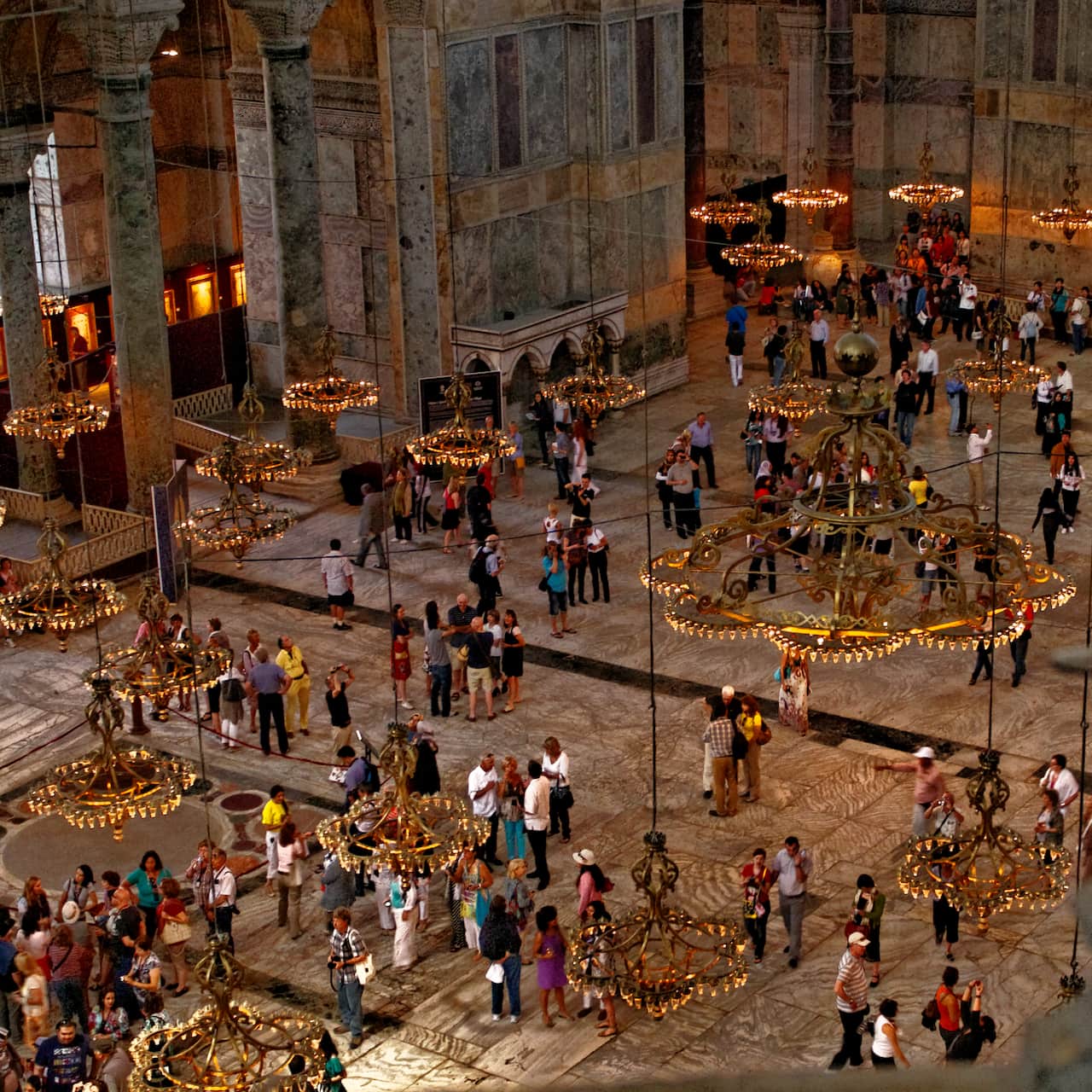
ID 29349658 @ Serban Enache | Dreamstime.com
Although the dress code for men is less restrictive than for women, it is by no means optional. Entering a mosque like Hagia Sophia still involves rules of respect that must be followed carefully.
What is required?
- No to shorts above the knee
- No to tank tops or sleeveless shirts
- Yes to short- or long-sleeved shirts
- Remove your hat before entering
In short, no beach or gym looks. Clothing should be understated and opaque, but there is no need to wear formal clothes.
If you arrive in shorts, a cover-up will be provided at the entrance, similar to a sarong or long skirt to wear over your clothes.
What about shoes?
As with everyone, you will need to take them off before entering. You will receive a plastic bag to take them with you during your visit. With or without socks, it makes no difference.
A tip to keep in mind
Avoid gestures considered disrespectful within the place of worship, such as keeping hands in pockets during the visitation, using high tones of voice or overly casual attitudes, or taking pictures of worshippers during prayer.
Attitude also matters as much as clothing.

The absolute best seller
Hagia Sophia: Skip-the-line ticket
Avoid the ticket line and enter Istanbul’s most impressive mosque
Secure payment
Instant confirmation
Mobile ticket
Dress code for children
If you are traveling with children, you can breathe a sigh of relief: the dress code rules for them are much more flexible.
What do the regulations say?
- Children under 9-12 can enter without special restrictions
- No headscarf requirement for younger girls
- No coverage required for legs or shoulders, but sober clothing is always recommended
The general guideline is common sense.
No need to dress them like little adults, but avoid tank tops, swimsuits, mini shorts or tops that are too revealing. A T-shirt and shorts below the knee are perfect.
A practical tip for summer
Children feel most comfortable in light but opaque clothes. Always carry an extra T-shirt and long shorts with you so you can make a quick change before going inside.
Remember: this is not a matter of strictness, but of respect for a sacred place where adults and children share space with praying worshippers.
Mosque Istanbul how to dress: useful info

ID 18427859 @ Halil Ibrahim Inci | Dreamstime.com
Where to find veils and covers in Istanbul?
If you arrive in Hagia Sophia without suitable clothing, no problem: you can buy everything you need right on the spot. No need to shop before you leave or rummage through your suitcase looking for improvised solutions.
Right next to the official ticket office, in front of the Ahmed III fountain, you will find a well-equipped counter where veils to cover your hair and body coverings are distributed.
The cost is affordable: 1 euro for the veil, 3 euro for the body cover.
You can choose to buy or rent, depending on your needs.
Everything is provided quickly and neatly, so you can enter the site in a rule-compliant, stress-free manner. Employees at the entrance are available to explain how to wear the covers correctly if you have never done so before.
While it is convenient to have this option on hand, the advice remains the same: prepare ahead of time if you can. Bringing a scarf, light scarf, or sarong with you will save you unnecessary lines and money.
Accessories and practical details
Once you have passed the entrance to the Hagia Sophia Mosque, there are some simple practical rules that you should be aware of. Although these are not actual religious obligations, following these directions will make your visit smoother and more respectful.
First of all, shoes should be removed. This is a common practice in all mosques. At the entrance, you will be given a plastic bag where you can store them and take them with you on the walk. It is not mandatory to wear socks, but if you prefer not to walk barefoot, you can safely keep your socks on. The floor is clean and well-maintained.
If you are traveling with young children and have a stroller with you, you should know that you will not be able to push it inside the visiting area. The route includes ramps and climbs that are not wheel-friendly. You will be asked to fold the stroller and carry it by hand during the visit.
As for photographs, they are allowed in almost the entire visitable area. However, there is an unwritten but fundamental rule: do not photograph worshippers during prayer. It is an intimate and sacred moment, and while it may seem like an evocative scene to you, it may be perceived as disrespectful to them.
Also avoid carrying excessively large backpacks, food or drinks. They are not explicitly forbidden, but they may be inconvenient and inappropriate for the context. If you can, travel light: a small bag or compact backpack is more than enough.
Finally, remember that Hagia Sophia is not just a historical monument, but a place that is still lived in. Move quietly, walk slowly, avoid talking loudly. These details are also part of the experience.
Conclusion
Visiting Hagia Sophia is not just a visual or historical experience.
It is also a direct encounter with a living culture, with the everyday spirituality of those who enter that place to pray, not to take a picture. And for that very reason, dressing appropriately is not an imposed rule, but a sign of respect.
There is no need to change identity, only to adapt to a context different from one’s own, with simplicity and openness. Wearing a veil, covering your shoulders or taking off your shoes are small gestures, but they say a lot. They tell that you are aware of where you are. That you are entering a shared, sacred, lived space.
Hagia Sophia is a bridge between worlds, between religions, peoples and centuries. Today, more than ever, it reminds us that the most beautiful journey is not the one in which we take our habits everywhere, but the one in which we learn something new, even if only by putting a scarf over our heads.

The best-selling ever
Hagia Sophia: Skip-the-line ticket
Avoid the ticket line and enter Istanbul’s most impressive mosque
Secure payment
Instant confirmation
Mobile ticket
