
If you are planning a trip to Istanbul, it is virtually impossible not to come across Hagia Sophia.
It appears everywhere: in guidebooks, in travel reels, on postcards, in the stories of those who have been there. But when it comes time to actually decide whether to visit it, the uncertainties begin.
Is it really worth spending time there? Is it fair to pay a ticket? What do we see today that it has become a mosque again?
And again: does the experience live up to its reputation or is it in danger of being a tourist disappointment?
The truth is that Hagia Sophia is not just an attraction. It is a place charged with history, symbolism, transformation.
Once a Christian basilica, then a mosque, then a museum, now a mosque again. And each phase has left visible – or hidden – marks within its walls.
In this article you will find a clear and concrete guide to whether it really makes sense to include it in your itinerary.
I’ll talk about the experience of visiting, what you can really see, how much it costs, and whether the price is justified.
There will also be the voices of tourists who have been there, mixed opinions, times when it may be best to avoid it–and times when it may be one of the best things to do in Istanbul.
And if you eventually decide to go, you’ll also find a useful link to buy a ticket or explore the options available on the Hagia Sophia ticket page.

Best Selling Ever
Hagia Sophia: Skip-the-line ticket
Avoid the ticket line and enter Istanbul’s most impressive mosque
Secure payment
Instant confirmation
Mobile ticket
Is it recommended to visit Hagia Sofia?
What does it feel like to visit Hagia Sophia today?

ID File 20441686 | © Artur Bogacki | Dreamstime.com
Visiting Hagia Sophia today is not like entering a museum.
It is an experience that lies somewhere between cultural tourism and respect for an active place of worship.
Since 2020, when it became a mosque again, things have changed quite a bit for those who come as mere visitors.
As soon as you arrive in the area, you know immediately that you are in an important place.
The dome, the minarets, the crowds. The first visual impact is powerful, although you may arrive with some doubt.
There is often a line at the entrance, but it flows. If you are a foreigner, you enter only from the Topkapi Palace side, no longer from the main square.
That entrance is reserved for the Turkish faithful.
Once inside, you immediately feel that the atmosphere is different from any other tourist site.
You can’t walk around freely everywhere.
The ground floor is reserved for Muslim worshipers during prayers, and this happens five times a day.
It means that at certain times you cannot enter the central area and have to stay on the side aisles.
It can be frustrating if you arrive at a bad time, especially if you are short on time.
Another thing to keep in mind: you can no longer take classical guided tours inside, even with a private escort. If you want to understand what you are looking at, you have to download the official audio guide, available in 23 languages.
It’s not the same, but it’s better than just wandering around.
You will also have to take off your shoes and cover yourself properly: shoulders, legs and-for women-hair.
There are scarves available at the entrance, but if you want to avoid queues or hassle, it’s best to arrive already prepared.
In short, entering Hagia Sophia today requires some adaptation. You are no longer in a museum where you can walk around without rules. You are in a sacred place that has regained an active religious function, and you can feel it in every detail.
What can you really see inside?

ID File 50523955 | © Saiko3p | Dreamstime.com
When you enter Hagia Sophia, what strikes you immediately is the majesty of the space.
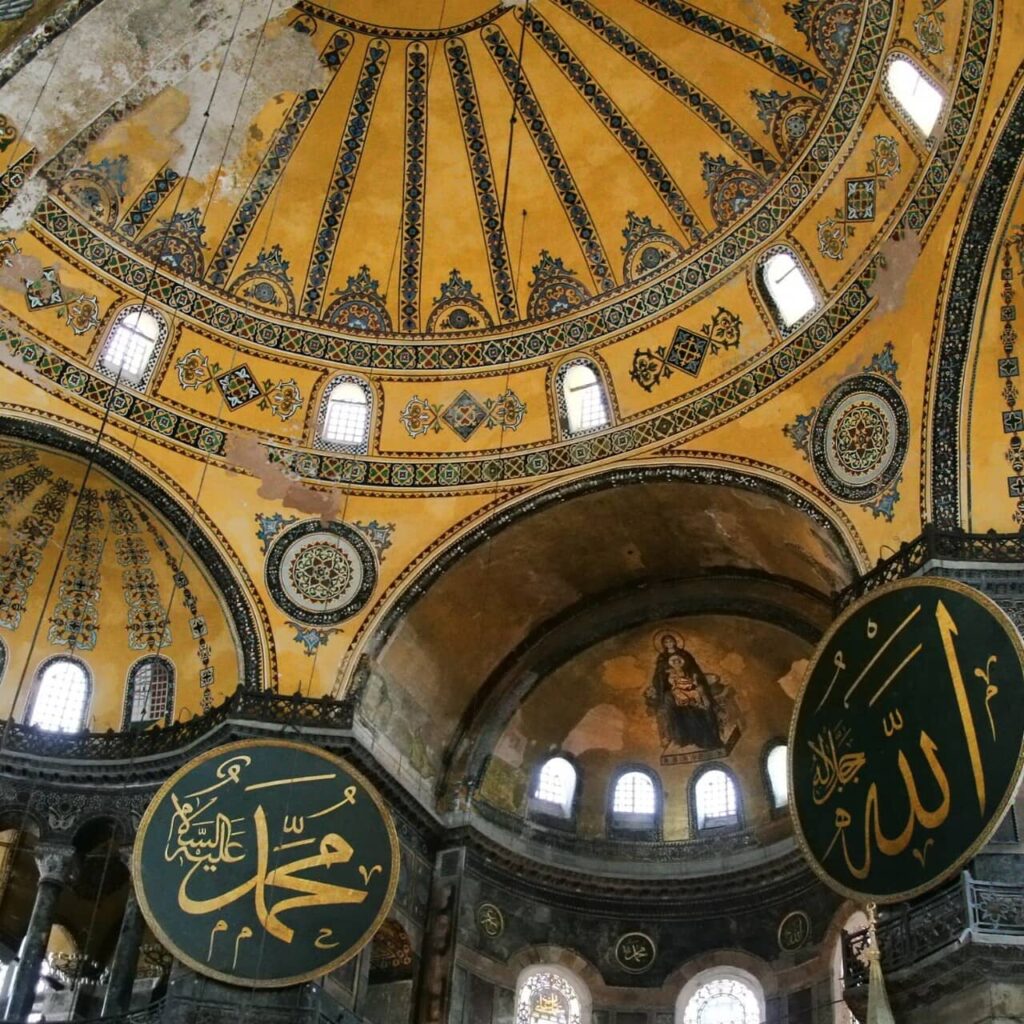
The suspended dome, the polychrome marbles, the towering columns, the giant Arabic calligraphy. Everything seems to want to shout to the world how special a place it has been, and still is.
But the question that really interests us is: what can you see today?
The answer is: not everything, and not always.
Many of the original Byzantine mosaics, which for years were one of the main reasons to visit, are now partly covered.
Some have been obscured with curtains or panels; others can still be glimpsed, but visibility is reduced. This is because, as it has returned to a mosque, Christian holy images cannot be displayed during prayer.
One of the highlights, however, remains the architecture. It is impossible not to be impressed by the large central nave, the light filtering through the tall windows, and the contrast between Byzantine lines and Ottoman elements.
Medallions with the names of Allah, Muhammad and the caliphs stand out over spaces that once housed Christian icons. Although you cannot see everything, you feel the weight of history layered before your eyes.
Another important detail: there are no more explanatory signs or information panels inside. Nor are there captions. This is why the audio guide has become essential if you want to understand what you are looking at.
So yes, the visual impact remains powerful, but the experience today is more limited than when Hagia Sophia was a museum.
If you are a fan of Byzantine art, you might be a bit disappointed. If, on the other hand, you are interested in the charm of the whole, the symbol, the atmosphere then the wow effect is still there.
Is it a good investment?

ID File 50523955 | © Saiko3p | Dreamstime.com
Until recently, entering Hagia Sophia was free. All you had to do was stand in line, take off your shoes, and obey the rules.
But since January 2024, everything has changed for foreign tourists: an entrance fee has been introduced.
You only pay the ticket if you are a non-Muslim visitor or if you enter for tourism.
Turkish citizens who go to pray continue to get in for free – and that’s only fair, since we’re talking about an active mosque.
But for you, traveler, it is now a paid experience, on par with other monumental attractions.
Now, we come to the key question: is the cost of the ticket really worth the visit?
It depends on what you are looking for.
If you are passionate about architecture or want to see a symbol of universal history live, probably yes.
Hagia Sophia remains a unique place in the world that you cannot directly compare with anything else.
But if you are especially interested in the mosaics, frescoes and artistic details, you should know that many of these elements are partially or completely covered today.
In terms of comparison, the Topkapi Palace ticket costs less, but the experience is much richer in terms of rooms, objects, context. The Basilica Cistern gives you an immersive and visually striking experience for a similar price.
And the Blue Mosque, just across the square, is still free, although it is often partially under restoration.
What’s more, with the Hagia Sophia ticket you get no privileged access, no guides, and no explanations. The audio guide is included, but the visit remains individual and, in some ways, bare bones.
In short, it’s a good investment only if you know what you’re buying: a fragment of history, not a museum full of visual content.
Want to check up-to-date prices, hours, and admission methods? You can do so directly at our tickets page.

Best Selling Ever
Hagia Sophia: Skip-the-line ticket
Avoid the ticket line and enter Istanbul’s most impressive mosque
Secure payment
Instant confirmation
Mobile ticket
Reviews for Hagia Sofia
Those who visit Hagia Soph ia today take home an experience that leaves a lasting impression. Sure, there are aspects that can be perfected, but the overall judgment-especially if you arrive prepared-tends to be positive.
The first thing that strikes everyone is the power of the architectural space.
To enter under that dome suspended 55 meters high is something that is hard to forget.
The combination of natural light, monumental proportions and religious silence creates a truly unique atmosphere.
Even without reading a guidebook, you can clearly sense that you are not in just any building, but in a place that has spanned centuries and empires.
Many people appreciate the fact that Hagia Sophia is not a cold, immobile museum, but a place that is still alive.
Its current function as a mosque gives it back an aura of authentic spirituality, which for some adds depth to the visit. You are not just a tourist looking on, you are a guest in a space that still plays a role in the present.
Of course, there are also criticisms. Some visitors are disappointed to see that the famous Byzantine mosaics are partially covered, but it is important to understand that this is done out of respect for the present religious function.
This is not neglect, but a cultural choice that reflects the present-day identity of the place.
If you are particularly interested in these elements, the audio guide will help you identify and understand those that are still visible.
Another recurring observation concerns the restriction of access at certain times of the day, during prayer.
But even this, if lived in the right spirit, can become part of the experience: seeing people who really use this place for faith can offer a perspective beyond just a tourist visit.
Then there are visitors who expect a more structured experience, with explanatory panels or guided tours.
But it is precisely the absence of a rigid “tourist direction” that makes the encounter with Hagia Sophia intimate, personal, and unfiltered.
It is the kind of place that speaks for itself, and should be listened to with time and attention.
In conclusion, those who enter Hagia Sophia knowing what they will find-and what they will not-often leave enriched and grateful to have seen it live.
If you’re looking for a place that blends history, art, religion and identity, this experience still has a lot to offer.
Better to go inside or look at it from the outside?

File ID 5828709 | © Nexus7 | Dreamstime.com
If you are still considering whether it is really worth entering Hagia Sophia, you may have already asked yourself this question: isn’t it enough to see it from the outside?
And it is a more than legitimate question.
Because yes, Hagia Sophia is splendid just to look at from the outside.
The view from Sultanahmet Square, with the Blue Mosque in the background and the sunset coloring its domes, is one of Istanbul’s most iconic sights. It is free, immediate, photogenic.
And for many hurried visitors, it may seem enough.
But if you stop there, you miss something essential.
Hagia Sophia is not just a beautiful facade.
It is the layering of its interior spaces, the surprise effect when you look up, the contrast between the light and the shadows, the silence interrupted only by a few low voices or the singing of the muezzin.
Only inside can you understand how much it has been, for centuries, the center of the spiritual and political world of two empires.
Of course, the experience today is different from a few years ago.
Some artistic elements are covered, some areas not always accessible. But the atmosphere once inside cannot be replaced with a photo from a distance.
It is there that you feel its real dimensions, the emptiness full of meaning, the sound of your footsteps on the ancient marble. Entering it makes you feel part of a living history.
Then there are the details: the porphyry columns that arrived from Ephesus, the large Ottoman calligraphic medals, the Christian signs carved in stone, the lights that change throughout the day. These are all things you cannot even imagine from the outside.
So if you are in doubt between stopping in front or taking the step and going in, the answer is: if you can, go in.
It won’t be perfect, it won’t be a museum in the classic sense, but it will be an authentic, your own, unrepeatable moment.
When it’s really worth it

File ID 5828709 | © Nexus7 | Dreamstime.com
Hagia Sophia is not an attraction to be “popped up” randomly in an itinerary. To really enjoy it, there are moments, situations and types of travelers for which it is much more worthwhile than others.
If you love history, you will find bread for your eyes and mind here.
Hagia Sophia is a bridge between worlds: built in the 6th century, it has been a Byzantine church, an Ottoman mosque, a secular museum and now a mosque again.
Each era has left its mark, and observing how Christian and Islamic elements coexist (or hide) is a fascinating exercise for those who know how to look.
If you travel for architecture and design, the structure leaves you speechless.
Even today, despite some limitations, the central dome, light play, materials, and volumes give you a powerful sensory experience.
It is even more worthwhile if you also visit the Blue Mosque and Topkapi Palace: you will see how they talk to each other, respond to each other, and influence each other.
Those who like to travel leisurely, observing, reflecting, will find in Hagia Sophia a suspended time. But you need the right predisposition. If you are in a hurry, if you want to see “everything and now,” you risk experiencing it only on the surface.
The time of day also makes a difference. Early morning and late afternoon hours are quieter, both in terms of attendance and atmosphere. Avoid prayer times if you can, because access to the ground floor will be limited and you may miss the most important parts.
Hagia Sophia is also really worthwhile if you are interested in Istanbul’s present, not just its past. Its conversion to a mosque in 2020 has generated strong discussions and symbols.
To experience it today is also to observe a place that represents the tensions, identities, and choices of contemporary Turkey.
It is a living lesson for those who want to understand more, not just see.
If, on the other hand, you have very little time in the city, or are more drawn to immersive experiences, perhaps the Basilica Cistern or a cruise on the Bosphorus can give you more satisfaction in less time.
But if you want a visual and spiritual synthesis of the city, Hagia Sophia remains one of the densest experiences Istanbul has to offer.
Conclusion
So, is it worth visiting Hagia Sophia in Istanbul?
The most honest answer is: it depends on what you are looking for.
If you just want to “check off a list” and see something spectacular in a few minutes, you might be a bit put off. You won’t find a traditional museum or total freedom of movement.
Some icons are covered, some areas not always accessible.
But if you are curious, open-minded, ready to listen to history with your eyes and some silence, Hagia Sophia can still give you an intense experience. It is a living, layered, sometimes contradictory place – just like Istanbul. Its beauty is not immediate or perfect, but it is real.
The key to really appreciating it is to know where you are entering.
Don’t expect what it can’t give you. Leave room for what can surprise you.
If your idea of travel includes authentic emotions, living history, and a hint of mystery, then yes: Hagia Sophia is definitely worth experiencing.
And if you have decided to do so, on our tickets page you can find everything you need to plan your visit!
The best seller ever
Hagia Sophia: Skip-the-line ticket
Avoid the ticket line and enter Istanbul’s most impressive mosque
Secure payment
Instant confirmation
Mobile ticket
